The Role of Curvature in Shape Recognition

Curvature is a pervasive feature of the visual world, present in both natural and man-made objects. Evaluating the curvature of object boundaries and surface contours is therefore a fundamental component of visual processing. From an ecological perspective, analyses of natural scene statistics provided evidence for the prevalence of co-circular contours in our visual environment, which may provide important cues for the visual system. There is a long tradition of research investigating the role of curvature in shape and object perception. Evidence from psychophysics and neurophysiology suggests that the visual system contains mechanisms that are selectively sensitive to curvature and that these mechanisms may contribute to the formation of object representations. In this talk, I review behavioural and physiological evidence indicating that curvature plays an important role in shape perception, with particular emphasis on specific curvature points, such as local curvature extrema. I will focus primarily on psychophysical findings while relating them to current physiological knowledge and computational models of shape representation. The aim is to evaluate the extent to which curvature-based representations can account for shape perception and to discuss their limitations within a broader framework of object recognition.

Program

Posted
AuthorGunnar Schmidtmann

Connecting the dots - Recognition of artificial and natural shapes relies on representing points of high information

Gunnar Schmidtmann, Nicholas Baker, Kevin J. Lande, Filipp Schmidt

Physiological and psychophysical evidence suggests that the visual system represents object outlines based on prominent curvature features, in particular regions of extreme curvature (such as convex maxima and concave minima). Curvature extrema often coincide with points of high information content (“surprisal,” in information-theoretic terms). However, this relationship is only correlational. To date, no study has directly compared the role of curvature extrema with the role of surprisal itself. Does the visual system selectively encode curvature extrema because they tend to be informative—because they are heuristic proxies for high-surprisal points along the contour—or does it directly encode informative points that happen often to be located at curvature extrema? We addressed this question in a series of shape-matching experiments, testing how curvature extrema and information content contribute to recognition. Observers (N = 7) matched a smooth test shape to one of two re-scaled shapes (target and distractor) constructed by connecting, with straight lines, points corresponding to (i) curvature maxima, (ii) both curvature maxima and minima, or (iii) points of maximum surprisal. A baseline condition used identical test and target shapes. Stimuli included artificial shapes composed of compound radial frequency patterns and natural shapes (animal outlines), the latter enabling us to disentangle curvature and information effects by restricting sampled points. Recognition performance was higher for natural than artificial shapes (95% vs. ~86%). Performance for shapes containing a few points of high information matched performance on trials containing all curvature extrema and baseline trials. It also exceeded performance for shapes with curvature maxima alone (65% vs. ~90%). These findings suggest that shape representation emphasizes features with high informational content rather than curvature extrema per se.

Schmidtmann, G., Baker, N., Lande, K. J., & Schmidt, F. (2025). Connecting the dots—Recognition of artificial and natural shapes relies on representing points of high information. bioRXiv. https://doi.org/10.1101/2025.11.17.688832

Posted
AuthorGunnar Schmidtmann

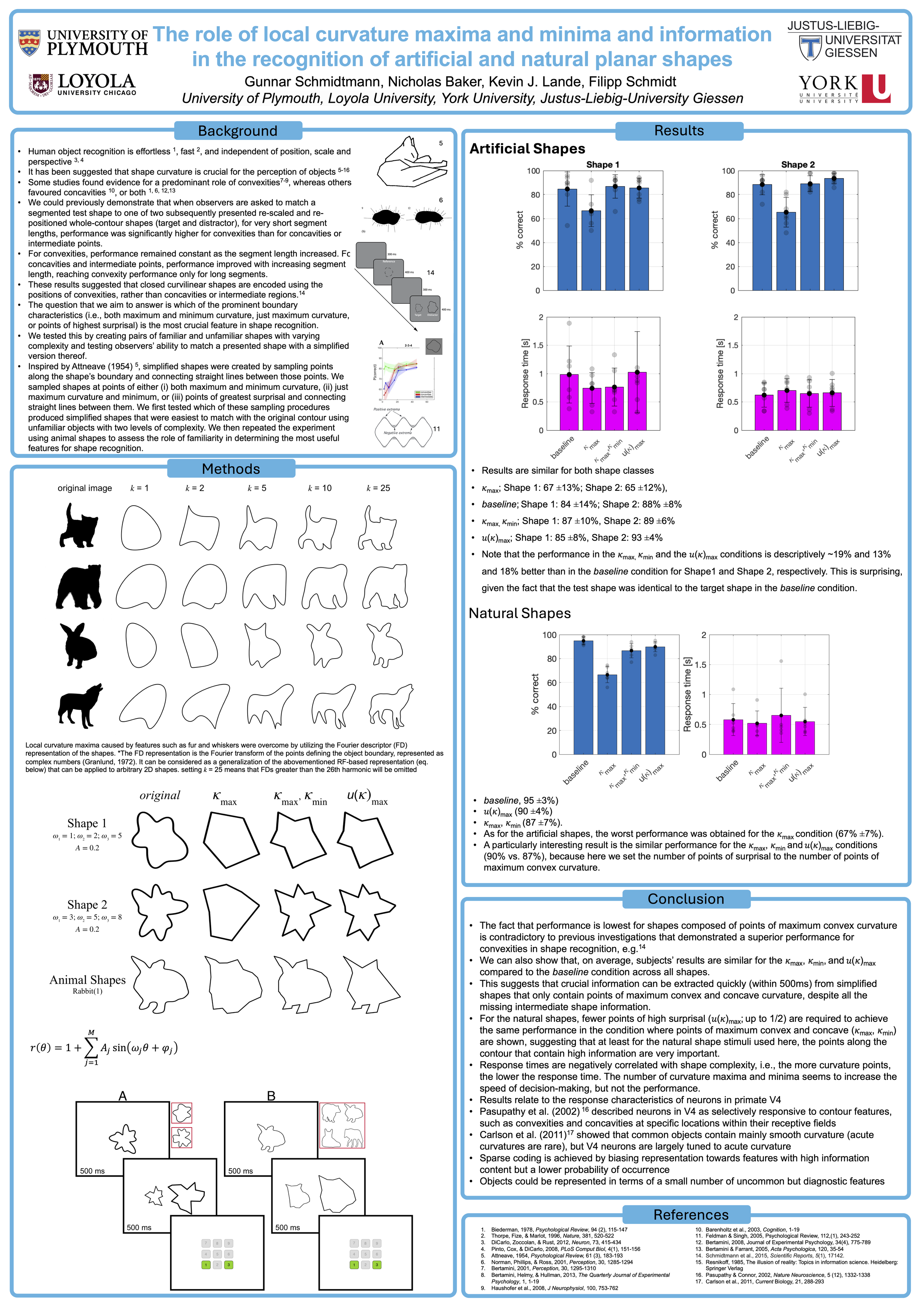
The role of local curvature maxima and minima and information in the recognition of artificial and natural planar shapes

 Gunnar Schmidtmann, Nicholas Baker, Kevin J. Lande, Filipp Schmidt

Eye & Vision Research Group, University of Plymouth, Plymouth, United Kingdom

Department of Psychology, Loyola University Chicago, Chicago, IL, United States

Department of Philosophy, Centre for Vision Research, York University, Ontario, Canada

Justus Liebig University Giessen, Department of Psychology, Giessen, Germany

The visual system is confronted with a vast number of shapes, both natural and artificial. Despite huge variation in the structure of objects and their retinal projections, humans recognize shapes quickly and accurately. How does the visual system represent this variety of shapes? There is a long history of theoretical and experimental investigations concerning the importance of specific features in shape recognition. Psychophysical evidence suggests that local curvature maxima (convexities) or minima (concavities) are of importance, and physiological studies found populations of V4 neurons selectively responsive to these features. Theoretical work using information theory shows that regions of curvature minima carry greater information than corresponding regions of curvature maxima. To study the role of points of curvature extrema and high information, we conducted a series of shape-matching experiments. The task for the observers (N=7) was to match a smooth reference shape (artificial or animal shape) to one of two subsequently presented re-scaled shapes (target and distractor), where the points of (i) maximum, (ii) maximum and minimum curvature, or (iii) maximum information were extracted and connected with straight lines. We also tested a baseline condition where the reference and target shape were identical. Results show that (i) performance is slightly better for natural than artificial shapes (95% vs. ~86%); (ii) performance for target shapes containing both, points of maximum and minimum curvature, and high-information content is equal to the baseline condition, but significantly better than performance for shapes only containing points of maximum curvature (65% vs. ~90%). Contrary to previous findings, points of curvature maxima alone do not provide sufficient information. Presenting points of maximum and minimum curvature or points of maximum information led to a significant gain in recognition accuracy, supporting the hypothesis that the visual system encodes shapes by biasing representation towards features with high information content.

Posted
AuthorGunnar Schmidtmann

Clinical Vision Science - A Concise Guide to Numbers, Laws, and Formulas - Second Edition

Schmidtmann, G., (2025). Clinical Vision Science - A Concise Guide to Numbers, Laws, and Formulas - Second Edition, Springer International Publishing, ISBN: 978-3-031-83320-5, DOI: https://doi.org/10.1007/978-3-031-83321-2

Softcover ISBN: 978-3-031-83320-5

eBook ISBN: 978-3-031-83321-2

This second, fully revised edition retains the familiar structure with the addition of more detailed descriptions and improved illustrations throughout the chapters. Most chapters now offer example calculations and exercises to grasp the fundamentals effortlessly. Delve deeper into the Anatomy & Binocular Vision chapter, which has been extended and enriched with illustrations of the exterior eye, visual pathways, and pupil reflexes with references to some pathologies in greater detail, enhancing your understanding of these crucial topics. All chapters have been expanded to provide previously limited explanations to fill in any gaps in knowledge. The Useful Numbers & Equation chapter has been further developed to include some key numbers and interesting facts about the eye and visual system and essential content on statistics, including normal distribution, standard deviation, confidence intervals, and median.

Clinical Vision Science: A Concise Guide to Numbers, Laws, and Formulas, 2nd Edition, features new example questions, calculations, and exercises to challenge and solidify understanding at the end of each chapter. Extended Further Reading references in each chapter have been included to keep up to date with the latest advancements in the field. Whether you're an expert or a newcomer, this revised edition is an indispensable companion to enhance your knowledge and skills in clinical vision science.

Posted
AuthorGunnar Schmidtmann

Investigating Age-Related Decline in Sensorimotor Control Using Robotic Tasks

Laura Alvarez-Hidalgo, Ellie Edlmann, Gunnar Schmidtmann, Ian S. Howard

Background: Aging is linked to widespread changes in sensorimotor control, leading to functional decline, mobility limitations, and an increased risk of falls. Certain aspects of the neurological examination and assessment of the motor system are subjective, underscoring the need for objective and quantitative tools to evaluate sensorimotor performance. Methods: To address this, we designed three experimental tasks using the vBOT planar robotic manipulandum to compare sensorimotor performance in healthy young adults (<35 years) and older adults (>60 years). Unlike previous assessments, our tasks uniquely integrate simultaneous bimanual control and altered dynamic conditions to comprehensively assess sensorimotor capabilities. The first task involved a bimanual de novo motor learning paradigm in which participants coordinated both hands to control a virtual 2D arm and performed 400 center-out and out-to-center trials. The second task assessed unimanual control using the right hand to perform center-out movements to eight targets. It introduced dynamic forces simulating object manipulation during the final 200 trials. The third task was similar but applied a viscous force field in the last 200 trials. It also included a scoring mechanism rewarding brisk movements, thereby encouraging participants to perform closer to their maximum capabilities. In this task, performance was also compared between the dominant and non-dominant arms. Group comparisons and within-subject differences were evaluated using appropriate statistical analyses. Results: Each task effectively identified age-related differences, but the viscous resistance task proved particularly sensitive, capturing significant age-related declines in force generation and movement duration. This scoring approach likely amplified performance differences, highlighting its suitability for detecting subtle effects of aging. Older adults generally showed slower movement, longer task completion times, reduced peak forces, and prolonged reaction times. However, individual performance varied, with some older participants performing on par with younger individuals. In the third experiment, the dominant arm showed consistently better performance than the non-dominant arm, underscoring the sensitivity of the metrics to lateralized differences in motor control. Conclusions: These findings suggest that robot-based tasks have potential to quantify age-related differences in sensorimotor control and may support more precise clinical assessments.

Alvarez-Hidalgo L., Edlmann E., Schmidtmann G., Howard I.S. (2025). Investigating Age-Related Decline in Sensorimotor Control Using Robotic Tasks, bioRxiv 2025.07.07.663471; doi: https://doi.org/10.1101/2025.07.07.663471 [PDF]

Posted
AuthorGunnar Schmidtmann

Visual and vestibular functions in healthy older adults

Jonathan Green, Ellie Edlmann, Jonathan Marsden, Gunnar Schmidtmann

This study aimed to investigate visual and vestibular functions in healthy older adults.  We focused on functions that might reveal clinically important insights, especially concerning cortical changes expected in patients with mild traumatic brain injuries. A total of 50 older (mean age: 75, SD: ±7.75; range 62-95 years; 38 females) healthy participants were recruited and tested with a wide variety of visual and vestibular tests. A new tablet-based visual testing platform (PerZeption Inc.) was used to efficiently and quickly measure near visual acuity, the full contrast sensitivity function, and global motion coherence thresholds. Results showed normal, age-appropriate performance across all visual functions. To assess vestibular functions, all subjects were assessed with Dix-Hallpike, Supine Head-roll, and Head Impulse test (HIT). 7% of the subjects showed nystagmus, and 13% reported dizziness following Dix-Hallpike. 9% of the subjects reported dizziness following Supine Head-roll, and 17% showed saccades following HIT. The Rivermead Post-concussion Symptoms Questionnaire results showed that 20% of subjects scored between 16-35, indicative of post-concussion syndrome, despite a non-existent concussion. Subjects also underwent Vestibular Oculomotor Screening (VOMS), assessing headache, dizziness, nausea and fogginess (HDNF) provoked by Smooth Pursuit (SP), Horizontal/Vertical Saccades (H/VS), Vestibulo-ocular Reflex (VOR) and Visual Motion Sensitivity (VMS) tests. SP provoked HDNF in 6% of subjects, and saccades were observed in 46%. For H/VS, 4% were symptomatic, and inaccuracy was observed in 10%. VOR provoked HDNF in 10% and VMS in 19%. Overall, 25% reported mild-moderate HDNF symptoms for at least one component of VOMS. The most common HDNF symptom was dizziness. In summary, healthy older adults showed a higher rate of vestibular dysfunction than anticipated and symptoms which would be considered comparable to the effects of concussion in head-injured patients.

Click on image below for higher-resolution.

Posted
AuthorGunnar Schmidtmann

Investigating the repeatability and behavioral relationships of acuity, contrast sensitivity, form, and motion perception measurements using a novel tablet- based vision test tool

Jan Skerswetat, Peter Bex, Jonathan Green, Gunnar Schmidtmann

Introduction: Visual function tests are important in basic and clinical vision research but are typically limited to very few aspects of human vision, coarse diagnostic resolution, and a need for an administrator. Recently, the generalizable, response-adaptive, self-administered Angular Indication Measurement (AIM) and Foraging Interactive D-prime (FInD) methods were developed to assess vision across different visual functions. Here, we investigated the repeatability of these methods and investigated the relationship between outcomes.

Methods: 31 healthy participants (mean age: 39.7 ± 11.7; 13 females) were recruited. AIM and FInD platforms show a range of visual stimuli per display (4x4 stimuli) spanning ±2σ around an adaptively estimated perceptual threshold across multiple displays (e.g., Skerswetat et al., 2024, IOVS). Repeatability of near visual acuity, contrast sensitivity function (CSF), and form & motion coherence tasks were deployed on a tablet using both eyes. Bland-Altman analyses were performed to calculate the Coefficient of Repeatability (precision) and Mean Bias (accuracy). Linear regressions and hierarchal cluster analysis were used to investigate the relationship between outcome parameters.

Results: Table 1 shows the repeatability for all visual functions. AIM Form Coherence and FInD Form horizontal coherence showed significant retest bias; all other tests were bias-free. Cluster analysis revealed overall clustering of CSF, form and motion outcomes (Figure 1). There were significant correlations within CSF and between motion coherence outcomes but few significant correlations between form coherence outcomes (Figure 1).

Conclusions: AIM and FInD near vision tests are generalizable across multiple visual functions and are precise and reliable. Most functions tested were bias- free. Contrast, form, and motion outcomes clustered together, and contrast and motion outcomes correlated with one another. The combination of a generalizable, response-adaptive, and self-administered approach may be a suitable set of tests for basic science and clinical use cases.

Posted
AuthorGunnar Schmidtmann